
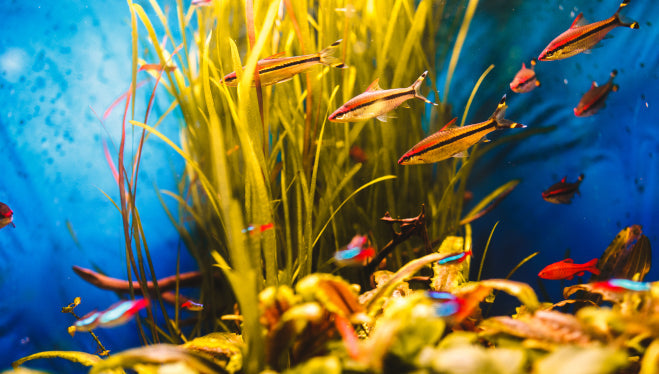
As autumn progresses, it's normal for some aquatic plants or marginal vegetation to enter a decaying phase: leaves yellowing, detaching, or falling into the substrate. While this is a natural process, allowing plant material to rot unchecked can have repercussions for the chemical and biological balance of the aquarium.
Decomposing leaves release tannins, humic acids, and other organic substances that affect values such as pH, organic load, and dissolved oxygen flow. In softer waters, the acidification effect is well-documented: the use of dry leaves is often employed in blackwater biotopes precisely to gradually lower the pH slightly.
At the same time, the accumulation of organic material that taxes the filter can overload filtration, cause ammonia or nitrite spikes, and create "dead zones" where decomposition proceeds in the absence of oxygen.
Main Risks to Monitor
-
Slow Acidification
Decomposition releases tannins and acidic compounds that can cause a moderate and slow drop in pH, especially in waters with low buffering capacity. -
Increased Organic Load
Decomposing material feeds bacteria, but if too abundant, it can saturate the mechanical or biological filter, promoting ammonia/nitrite buildup. -
Amber Water Coloration
Tannins, often appreciated in blackwater biotopes, can limit light penetration and disturb species that are not suited to this effect. -
Anoxic Zones in the Substrate
Leaves that compact at the bottom without being disturbed can degrade in oxygen-poor environments, generating harmful gases and compromising local water quality.
Effective Strategies for Managing Leaf Drop
Planned and Preventative Removal
Removing large, visible leaves before they fully deteriorate quickly reduces the release of organic substances. It's not necessary to remove every leaf; leaving a few secondary leaves can be tolerable if the load is contained.
Light Siphoning of the Substrate
Use a gravel vacuum to gently lift material in areas where leaves tend to accumulate (corners, low areas). You don't need to "clean everything," but avoid heavy accumulations.
Seasonal Pruning
Trim old branches or weakened parts of plants. This reduces the production of dead leaves and concentrates plant energy on healthy growth.
Fertilization and Nutrient Regulation
Since plants absorb fewer nutrients with less light and more decomposition, reduce the input of macro and micro elements to avoid excess that can feed algae.
Mixing "Active" and Inert Material
If you want to use natural leaves (for aesthetics or biotope), prefer already dry leaves, "stripped" of excess soluble substances: they release fewer nitrogen compounds than fresh leaves.
Constant Monitoring
Frequently check pH, ammonia, and nitrites. In case of abnormal values, perform partial water changes to relieve pressure on the filter.
When to Leave Some Leaves (and Why)
In certain natural setups, it is acceptable to leave a moderate layer of foliage as part of the "living substrate." In these cases:
-
The leaves must already be well-dried.
-
The filter and maintenance must cover the additional load.
-
The use of chemical filter media (carbon, resins) can be considered to mitigate excess tannins.
Many hobbyists admit that scattered, non-problematic leaves do not cause significant damage, provided they do not accumulate too much.
Conclusion
Leaf drop in autumn is a natural phenomenon that many aquarists can transform from a potential source of stress into a controllable and even aesthetic element. With reasoned removal, pruning, fertilization adjustments, and careful monitoring, you can prevent negative repercussions on the aquarium.