
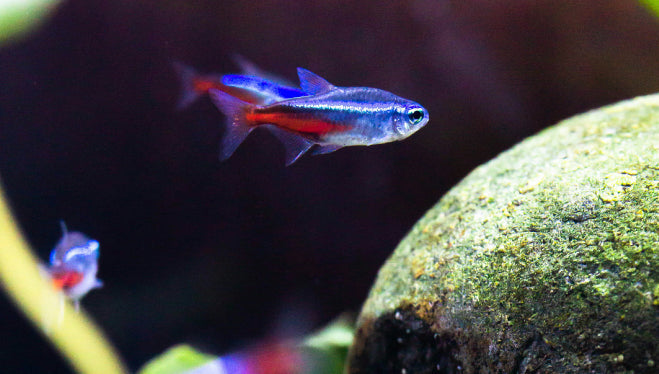
Creating an Amazonian biotope in an aquarium means recreating, as faithfully as possible, a small corner of the South American rainforest. It is one of the most fascinating and appreciated setups by aquarists, both for its natural aesthetics and for the possibility of hosting colorful fish and tropical plants.
But where do you start? In this article, we will guide you step-by-step through the design of an Amazonian-style aquarium, providing you with technical information, practical advice, and suggestions on the most suitable AQPet products to achieve a realistic, stable, and long-lasting result.
What is an Amazonian biotope?
An aquatic biotope is a faithful reconstruction of a natural habitat, respecting certain physical-chemical parameters, as well as the flora and fauna typical of a specific geographical area.
In the case of the Amazonian biotope, we are talking about freshwater, slow-moving or stagnant, slightly acidic waters rich in tannins. These are shaded environments, often with sandy bottoms, submerged roots, and lush vegetation. Iconic species such as neon tetras, discus, angelfish, and hatchetfish live here, as well as many varieties of floating and marsh plants.
Water parameters: the basis of an authentic biotope
To achieve a stable and realistic Amazonian biotope, it is essential to keep the water within certain values:
-
Temperature: 24–28 °C
-
pH: 5.5–7 (ideally around 6)
-
KH: low (1–3 dKH)
-
GH: low (up to 6 dGH)
-
Conductivity: 50–200 µS/cm
Recommended AQPet solutions:
-
Electronically regulated heaters to maintain a constant tropical temperature.
Setup: substrate, decorations, and lighting
Substrate
Use fine natural sand or very fine gravel. It is ideal for simulating riverbeds and allows plants to root.
Wood and roots
Roots or wood release tannins useful for the "blackwater" effect (amber water) and provide natural hiding places for fish.
Leaves and leaf litter
Adding dried leaves (such as Catappa or Oak) helps reproduce the forest floor, releases humic acids, and improves fish well-being.
Lighting
Opt for warm spectrum and not overly intense lights, simulating the light filtered by jungle vegetation. The effect will be more natural and relaxing for the aquarium inhabitants too.
The most suitable plants
In an Amazonian biotope, plants are essential for creating hiding places, absorbing nitrates, and oxygenating the water. Among the most suitable species are:
-
Echinodorus spp.
-
Anubias barteri
-
Hydrocotyle leucocephala
-
Ceratopteris thalictroides
-
Floating plants such as Salvinia and Pistia
What fish to put in an Amazonian biotope?
To remain faithful to the original habitat, choose species native to the Amazon region:
-
Neon Tetra (Paracheirodon innesi)
-
Cardinal Tetra (Paracheirodon axelrodi)
-
Discus (Symphysodon spp.)
-
Angelfish (Pterophyllum scalare)
-
Corydoras spp.
-
Apistogramma spp.
-
Otocinclus affinis (excellent cleaners)
Warning: respect the compatibility between species, especially if you intend to include cichlids (such as discus or apistogramma), and adapt the tank size accordingly.
Maintenance and biological stability
An Amazonian biotope requires care and patience, but with the right routine, it becomes a stable ecosystem:
-
Regular water changes with osmotic and remineralized water.
-
Constant monitoring of parameters with specific tests.
-
Moderate cleaning to avoid disturbing the biological balance.
Useful products:
-
External filters with advanced biological and mechanical filtration
-
Activating bacteria for fast and stable cycles
Conclusions
Setting up an Amazonian biotope in an aquarium is an exciting and rewarding challenge. It means bringing a piece of pristine nature directly into your home, offering fish a healthy and realistic environment.
Thanks to AQPet's specific products, you can achieve water similar to that of the Amazon, choose suitable decorations and plants, and ensure the well-being of your aquarium inhabitants.
? Discover the complete AQPet line for your Amazonian biotope!